
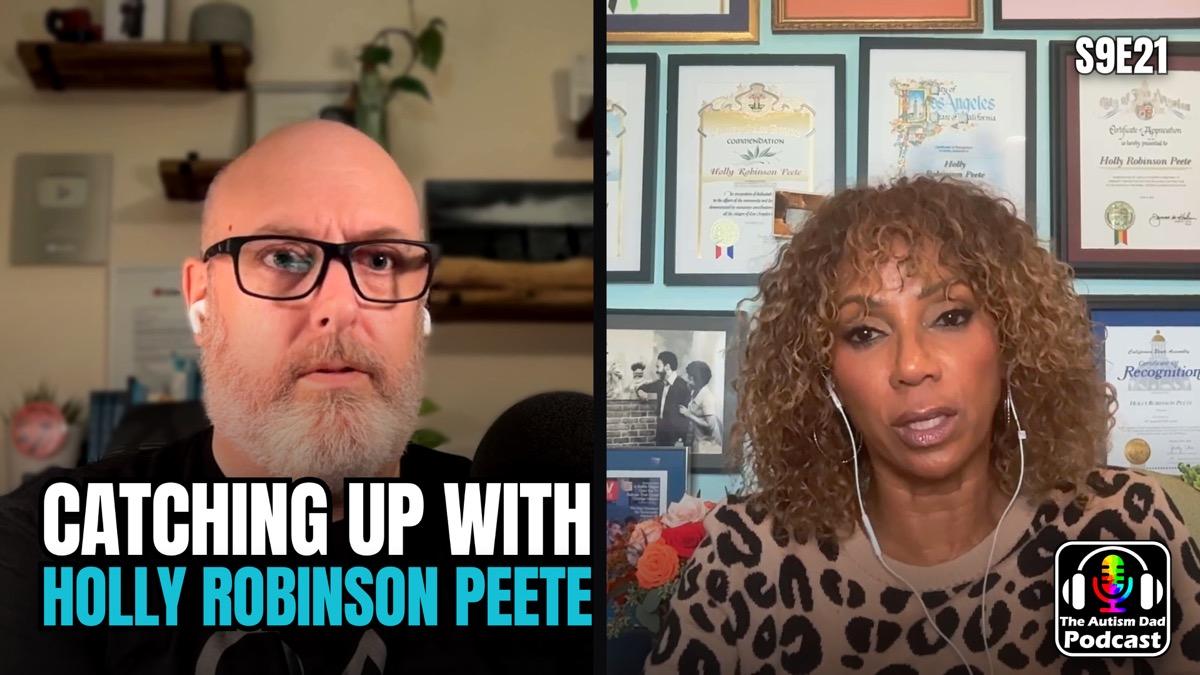
On the newest episode of The Autism Dad Podcast, Holly Robinson Peete talks about her son RJ, who masks all day long to get through a job he loves, why dads often take longer to come around to a diagnosis, and her first piece of advice for a scared, newly diagnosed parent. Build a team.
I've known Holly for a long time, and she and Rodney have been talking about RJ in public for years. That's helped a lot of families feel less alone. So when she finally came on the show, I wanted to talk about the gala and the foundation, sure. But mostly I wanted to ask her about the stuff that doesn't make the red carpet.
She was generous with it. Three things she said have stayed with me all week, and I think they're worth slowing down on, especially if your child was diagnosed recently.
1. Grown doesn't mean the worry is over
RJ is an adult with a job he loves. From the outside, that's the outcome every parent of a newly diagnosed kid is praying for. Holly was honest about what it actually costs him.
"He has to mask all day long and he is stressed. He's got a belly full of cortisol."
And then the line that stopped me.
"He just finished his 11th season and he still thinks he's going to lose his job."
Masking means hiding or suppressing the parts of yourself that might read as different, so you can get through the day without standing out. A lot of autistic people do it constantly, and it's exhausting. What people see is somebody doing fine. What they don't see is the energy it takes to look fine, and the crash that comes later.
After 25 years of being an autism dad, I can tell you this hit close to home. You spend the early years thinking that if you can just get them to the next milestone, the worry will ease up. Sometimes it does. Sometimes it just changes shape. If your kid is grown, working, and still carrying that fear around, you're not failing them. That's a real thing, and you're not the only one watching it happen.
I said something to Holly on the episode that I believe all the way down.
"When our kids are diagnosed, that's like a snapshot in time."
The diagnosis tells you where your child was on one day. It doesn't tell you who they'll be, and it doesn't tell you what will be hard for them later. Both of those things stay open.
2. Some dads take longer, and that's not the end of the story
Rodney didn't want to go public about RJ's diagnosis. Holly talked openly about that disagreement, and about why so many dads process a diagnosis differently. A lot of moms reading this are living that right now.
Here's the hopeful part. Rodney came around, and when he did, it changed things.
"When you dads come out, you speak on autism in a different way."
"Not to be corny, but our team needed our quarterback."
If you're the dad who isn't there yet, I'm not going to lecture you. Plenty of dads need more time with this than they'd ever admit out loud. But your family needs you on the field. And Holly's right, people hear it differently when it comes from a dad. I wrote more about that in Supporting Dads in the Autism Community.
3. Build a team, and don't wait on family to join it
I asked Holly what she'd tell a parent who just got the diagnosis and is scared. She didn't hesitate.
"Build a team around your son and daughter, son or daughter."
That team can be therapists, teachers, other parents, a support group, one friend who actually gets it. And Holly was honest about who might not be on it.
"Don't be disappointed if family doesn't get it."
That one is hard to hear, and it's also freeing. Some relatives come around and some don't, and your child can't wait on that. If you're dealing with it right now, this post on when someone doesn't support your child's diagnosis might help. Holly's promise is that the people do show up.
"You will find your tribe and your people."
What else we talked about
We recorded a week before DesignCare, the HollyRod Foundation's 27th annual gala. Holly told me about her dad, Matt Robinson, the original Gordon on Sesame Street, and the Courage Award named for him. She explained why HollyRod has two halves, Parkinson's because of her dad and autism because of RJ. She also talked about evaluation wait lists, how much depends on which neighborhood you live in, and why health care and voting matter so much to families like ours. You can learn more about the foundation's work at hollyrod.org.
The full episode, with show notes, is on the podcast site, and you can listen in Apple Podcasts right here.
Questions parents ask
What is masking in autism?
Masking is when an autistic person hides or suppresses autistic traits to fit in, like forcing eye contact, copying other people's reactions, or holding in stims. It can help someone get through a day at school or work, but it usually costs a lot of energy and can lead to stress and burnout.
What should I do first after my child's autism diagnosis?
Holly's answer is to build a team around your child. That means the professionals, educators, and other parents who will help you, and it's okay if not every family member is on it. You don't have to figure everything out in the first week. This post for scared, newly diagnosed parents is a good place to start.
Why do some dads struggle more with an autism diagnosis?
Every family is different, but a lot of dads take longer to talk about it openly. In Holly's family, Rodney didn't want to go public at first. Once he came around, she says, his voice made a real difference, because people hear dads talk about autism in a different way.
A note about my book
If your child was just diagnosed, I wrote a book for exactly where you are. So Your Child Was Just Diagnosed with Autism: Real Talk, Support, and Next Steps from a Dad Who's Been There comes out December 29, 2026 from Fair Winds Press. It's not a treatment guide. It's your compassionate first step guide from someone who's lived it. You can preorder it at theautismdad.com/book.
This episode is presented by VizyPlan, a platform that builds visual routines with pictures of your actual child doing each step. Try it free for a week at theautismdad.com/vizyplan-review.
Which of Holly's three lessons hit closest to home for you? I'd really like to know.


