By Rob Gorski, September 25, 2026
The short answer: On September 23, 2026, a federal judge in Texas erased six pieces of a 2024 federal health department rule, including the whole section requiring programs to serve disabled people in the most integrated setting. It applies in every state. Section 504 itself, the ADA and the Olmstead decision still stand.
Earlier this month I told you a judge still had to sign off on this. On September 23, he did.
If you've been scared since the headlines started, I get it. When the words "disabled people" and "institution" show up in the same sentence, every parent I know feels it in their chest. I feel it too.
So I read the whole thing. The judge's order is three pages. The request behind it runs eight. I read the parts of the rule it erased, word for word. Then I wrote it all down in plain language, because you deserve to understand exactly what happened without needing a law degree or a free afternoon.
First, what didn't change
I'm starting here on purpose, because this is the part people are getting wrong.
Your child's school 504 plan isn't in this. School 504 plans run on the Education Department's rules. This case was about the rules of a different agency, the Department of Health and Human Services. Even inside that agency's rule, nothing in the section on child care, preschool and K-12 schools was touched.
Nobody's services turned off. The order doesn't end a single service, waiver, placement or plan.
Section 504 is still the law. Congress passed it in 1973. Only Congress can change it, and Congress didn't.
The ADA didn't change. The order doesn't touch the ADA or its rules.
Medicaid's own rules weren't named. The order doesn't mention Medicaid's rules for home and community-based services at all.
Olmstead still stands. That's the 1999 Supreme Court decision that said the unjustified isolation of disabled people in institutions is discrimination. A trial judge can't overturn the Supreme Court, and this one didn't try.
The judge didn't rule that community living is unconstitutional. He wrote that the court decided nothing beyond the six pieces it erased.
Take a breath. Now let's walk through what did happen.
Why this one is personal
I've spent 25 years as an autism dad. My three sons are adults now. My oldest, Gavin, relies on Medicaid, and how he gets support where he lives is the question I think about most.
So when a court touches the rules about community living, I read every word. And I'm not going to soften what's real or blow up what isn't.
What happened, in plain words
In 2024, Texas and a group of other states sued the Department of Health and Human Services, which everyone calls HHS. They were fighting HHS's newly updated disability rights rules. The case started as Texas v. Becerra and became Texas v. Kennedy when Robert F. Kennedy Jr. took over HHS. If you want the whole backstory, I walked through it here.
Normally the federal government defends its own rules in court. This time it didn't. In June, the Justice Department's lawyers wrote a legal opinion concluding that "neither section 504 of the Rehabilitation Act nor Title II of the Americans with Disabilities Act ... imposed an integration mandate on states in their treatment of mentally disabled individuals." Their words, not mine. I broke that memo down when it came out.
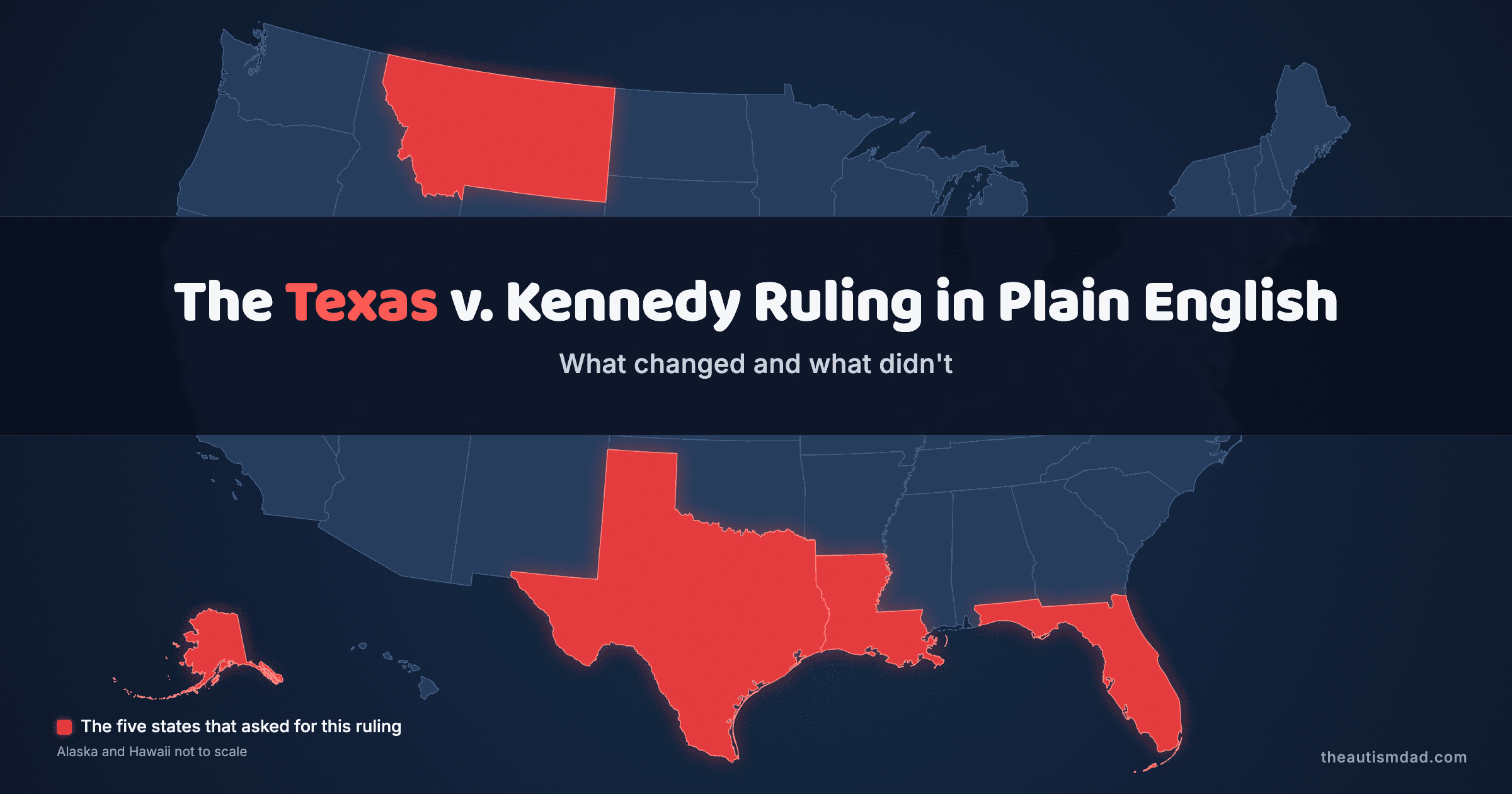
After that, the Justice Department, acting for HHS, stopped fighting. On September 1, it filed a joint request with five states, Texas, Alaska, Louisiana, Montana and Florida, asking the judge to erase the community integration parts of the rule and close the case.
On September 23, Judge James Wesley Hendrix of the Northern District of Texas signed it. He erased exactly the six pieces they asked for.
A few words you'll keep hearing
Section 504. A 1973 law that says programs getting federal money can't discriminate against disabled people. Your child's school 504 plan is named after it.
A law vs. a rule. Congress writes laws. Agencies like HHS write rules that spell out how to follow those laws. This case erased rules. The law itself is untouched.
HHS. The federal Department of Health and Human Services. Medicaid runs through HHS, which is why its rules reach so much of the disability service system.
Most integrated setting. The rule defined it as "a setting that provides individuals with disabilities the opportunity to interact with nondisabled persons to the fullest extent possible." In everyday words, living, working and getting services in the community like everyone else, with real choices about your own day.
Vacate. When a judge vacates a rule, it's erased. It doesn't apply to anyone, anywhere.
Olmstead. Olmstead v. L.C., the 1999 Supreme Court case. Two Georgia women, Lois Curtis and Elaine Wilson, were kept in a state hospital long after their own doctors said they were ready to leave. The Court said that kind of unjustified isolation is discrimination.
The six pieces the judge erased
The order lists six pieces of HHS's 2024 rule. Here's each one, what it said and what it meant. I'm quoting the rule's own words so you can see them for yourself.
1. The definition of "most integrated setting"
That's the definition I quoted above. Without it, HHS's rule no longer spells out what "most integrated" means. It was the foundation the other five were built on.
2. The one-sentence rule
Buried in the general rules was this: "A recipient shall administer programs and activities in the most integrated setting appropriate to the needs of qualified individuals with disabilities." A recipient is any program or organization that takes HHS money. This was the requirement in its plainest form. It's gone from HHS's rule.
3. The whole integration section
This is the big one. Section 84.76 was a full section on integration, and the judge erased all of it. It did five things.
It repeated the core requirement. Programs had to be run "in the most integrated setting appropriate to the needs of a qualified person with a disability."
It described what a segregated setting looks like. Places filled mostly or only with disabled people, where days run on rigid schedules, privacy is scarce, visitors are limited and getting out into the community is hard.
It listed things programs couldn't do, like offering better benefits to people in segregated settings than to people in the community, or putting stricter rules on people who choose the community.
It said that failing to provide community services, in a way that leads to someone being institutionalized or put at serious risk of it, counts as discrimination. That covered planning, funding and how services were designed.
And it gave programs a defense. If a change would "fundamentally alter" a program, the program could say so and push back. That balance was part of the rule, and it's gone too.
Here's the line from that section I keep coming back to: "Qualified individuals with disabilities need not wait until the harm of institutionalization or segregation occurs to assert their right to avoid unnecessary segregation."
In plain words, you didn't have to wait until your kid was already in a facility to push back. You could act when the risk showed up. That was the early warning. Of everything in this order, that's the loss I feel most.
4. A sentence about colleges
In the section on colleges and other higher-education programs that get HHS money, one sentence said a program had to "operate its program or activity in the most integrated setting appropriate." It's gone. That's the only piece that touched education at all, and it's the college section, not K-12.
5 and 6. Two "give priority" sentences
Two more sentences dealt with fixing access problems, one in older buildings and one in medical equipment like exam tables and scales. Both told programs to "give priority to those methods that offer programs and activities to qualified individuals with disabilities in the most integrated setting appropriate." Those two sentences are erased. The rest of both sections stays.
What's left of the 2024 rule
Everything else. The order lists these six pieces and nothing more. A coalition of seven national disability organizations put it plainly on September 24. The order "does not impact other portions of the 2024 HHS Section 504 Rule or any other agency's disability rights regulations."
Why it applies in every state, not just Texas
Five states asked for this, but the result isn't limited to them. When a court vacates a rule, the rule is erased for everyone. The judge explained it in a footnote, writing that "the universality of vacatur is intrinsic to that relief." In plain words, erasing a rule means erasing it everywhere.
The Justice Department didn't fight over that. In its filing, it said its general position is that rulings like this should only cover the people in the case. Then it said it "agrees not to pursue this position in this case." Nobody argued for a smaller ruling.
Why nobody is appealing
In most court fights, somebody loses, and the loser can appeal. Here, both sides asked for the same result, so there's no losing side. The order closes with this line: "The Clerk is directed to close this case."
The states' other claims were dismissed "without prejudice." One of them argued that these rules broke the Constitution's limits on conditions attached to federal money. Without prejudice means the states could bring those arguments back in a future case. The judge didn't rule on them either way.
What this means for your family
Today
Nothing turns off today. If your child gets services at home or in the community right now, this order doesn't end them.
What's harder now
The HHS rule that said all of this out loud is gone. Families and advocates can still make these arguments under the ADA, the Section 504 law itself and Olmstead. It's just harder, slower and more expensive when you can't point to a rule that says it in plain text.
And the federal government has told us where it stands. Between the June memo, this case and the Justice Department stepping back from its own Olmstead guidance in July (here's what that notice means), I wouldn't count on Washington to enforce community living for us right now. That's my read, not something the order says.
What nobody knows yet
What does this look like in your state six months from now? I don't know, and I'm not going to guess. States run a lot of this through their own Medicaid programs, and they'll each move differently. Anybody who tells you they know exactly what happens next is guessing.
What you can do
Here's the part that's real and in your hands. A law passed by Congress doesn't get erased the way a rule just did. Congress can write community living into Section 504 itself. States can write it into state law, and disability groups are already urging state legislatures to do exactly that.
I built a free kit that turns that call or email into about a minute of your time. Here's how to use it.
Go to theautismdad.com/takeaction.
Tap the box that says Defend Community Living.
Pick your state, then type your full street address with city and ZIP. It fills in the names of your senators, your representative and your state lawmakers. Your address is used once and isn't stored.
Copy the call script or the email and send it. There are a few blanks for your name and town. A line about your own family goes a long way. Staffers remember those.
If you live in one of the five states, your attorney general's name is on the joint request. That's Ken Paxton in Texas, Acting Attorney General Cori Mills in Alaska, Liz Murrill in Louisiana, Austin Knudsen in Montana and James Uthmeier in Florida. The kit doesn't look up attorneys general, so that call is a separate one.
And if today isn't the day for a phone call, that's okay. Taking care of yourself so you can keep going counts too. Here's how I handle the news without drowning in it.
Quick answers
Does the Texas v. Kennedy ruling affect my child's 504 plan at school?
No. School 504 plans run on the Education Department's rules, and the order doesn't name them. Even HHS's own rules for child care, preschool and K-12 weren't touched.
Is Section 504 gone?
No. Section 504 is a law Congress passed in 1973, and it's unchanged. The judge erased six pieces of HHS's 2024 rule about how to follow it.
Does the ruling only apply in Texas?
No. Vacating a rule erases it everywhere, so those six pieces are gone in every state.
Did the judge say community living is unconstitutional?
No. The order says the court decided nothing beyond the six pieces it erased. Olmstead, the Supreme Court's 1999 decision, still stands.
Will anyone appeal?
Both sides in the case asked for this result, so neither one has a reason to appeal, and the case is closed.
Does this cut Medicaid waivers or services?
The order doesn't cut any service or name any Medicaid rule. What it removes is HHS rule language that families could point to when a program pushed people toward institutions.
You're not behind
If you read all the way down here, thank you. I know this is a lot, and I know it's scary. You don't have to understand every legal term to protect your kid. You just have to know what's real, and now you do.
Which part do you want me to dig into next? Tell me on Facebook or Instagram.
Sources
Order and Final Judgment, Texas v. Kennedy, No. 5:24-CV-225-H (N.D. Tex.), September 23, 2026
Corrected Joint Motion for Entry of Final Judgment, September 1, 2026
Justice Department Office of Legal Counsel opinion, June 18, 2026
45 C.F.R. Part 84, HHS's Section 504 rule, on eCFR. The erased sections may still appear there until HHS formally removes them.
AAPD, Texas v. Kennedy Abandons Federal Commitment to Community Integration, September 24, 2026
National disability organizations' joint statement, September 24, 2026