Update, September 25, 2026: the judge signed it
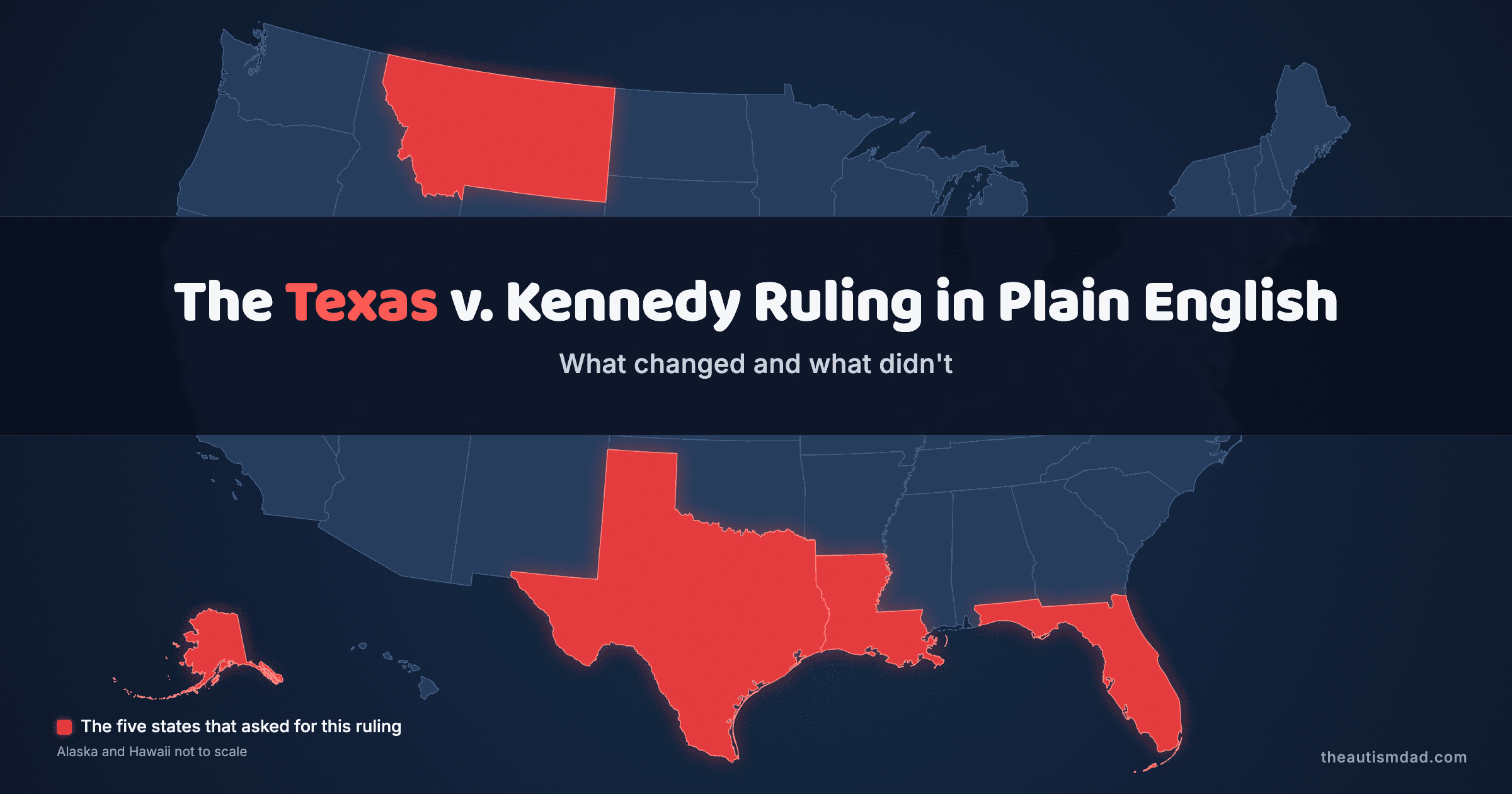
On September 23, 2026, Judge James Wesley Hendrix signed a final judgment in Texas v. Kennedy. It strikes the community integration provisions out of HHS's 2024 Section 504 rule, including the whole integration section and the definition of "most integrated setting." It applies nationwide, not just in the five states still on the case. The Justice Department and those five states asked for it together, so there's no losing side to appeal, and the case is closed.
Before you spiral, three things. Your kid's school 504 plan is not in this ruling. School 504 plans run on the Education Department's rules, and every provision struck here is an HHS rule. Nobody's services stopped because of this order. And Section 504 itself, the ADA, and Olmstead are all still the law. The order says in its own words that the court decided nothing beyond what it needed to strike those provisions.
Here's what's genuinely gone. The HHS rule said a family didn't have to wait until someone was already in an institution to push back. A decision that put them at serious risk of ending up in one was enough. That early warning is what got struck, and it's the part worth being angry about.
What you can do now is different from what this post said in July. There's no lawsuit left for a state to withdraw from, so the attorney general ask further down is over. This moves to Congress, which can write integration into the law itself, and to your statehouse, which can protect community living in state law. I updated the free scripts for both: theautismdad.com/takeaction/olmstead
You can read the signed order yourself. It's three pages: the September 23 order and final judgment
One correction to the July post below. It said six states were still in the case. Missouri withdrew on July 20, the day before this published, so five were left: Texas, Alaska, Louisiana, Montana, and Florida. I've fixed that in the text. The rest is the July 21 explainer as I wrote it, so you can see how we got here. Where it says a ruling is still coming, that was true in July and isn't now.
Last night a mom in my comments asked a question that deserved a better answer than a courtroom can give. She wrote, what is this Texas lawsuit everybody keeps posting about, and should I be scared?
Fair question. The case has had two names. The coverage is full of words like integration mandate and amicus. And the people it would hit hardest are parents who haven't slept a full night since the last IEP meeting.
So let's do this the way I wish someone did it for me. Plain words. Kitchen table. No law degree required.
First, if you feel behind on this story, you're not behind. You're parenting. Court dockets aren't written for people who are timing medication windows and fighting insurance on a lunch break. Needing a translation isn't a failure. It's the reasonable response to a system that doesn't explain itself.
The short version
Five states are asking a federal judge to strike down the rule that says disabled people get services in the community instead of in institutions. The federal government stopped defending that rule this month. And on Monday, the Justice Department put in writing that it won't rely on its own Olmstead playbook anymore.
That's the whole story in three sentences. Now let's slow down and walk through it, because the details are where the fear lives, and most of that fear shrinks once you can see the whole board.
Where this case came from
In September 2024, Texas and 16 other states sued the federal government. The case was called Texas v. Becerra back then, because Xavier Becerra ran the Department of Health and Human Services, and when you sue a federal agency, the case carries the name of the person in charge.
When Robert F. Kennedy Jr. took over HHS, the name on the case changed with him. Texas v. Becerra became Texas v. Kennedy. Same lawsuit. Same fight. If you've seen both names in your feed and wondered if there are two cases, there aren't. There's one, and it's moving.
The states sued over a set of updated rules protecting disabled people under Section 504 of the Rehabilitation Act. That's the 1973 law that says programs taking federal money can't discriminate against disabled people. If your child has a 504 plan at school, it's named after this law.
What they want struck down
The heart of the fight is something called the integration mandate.
Plain words: the integration mandate says disabled people get services in the most integrated setting possible. Home instead of a facility. A neighborhood school instead of a separate building. A real community instead of an institution.
It comes from Olmstead v. L.C., a Supreme Court case from 1999. Two Georgia women, Lois Curtis and Elaine Wilson, were held in a state hospital years after their own doctors said they were ready to leave. The Court called that what it was. Discrimination.
For my family, none of this is abstract. I've spent 25 years as an autism dad. My three sons are adults now, and a big part of why our life works is that support reaches them at home, in their community, not somewhere else.
At first, the states went even bigger than the integration rule. They argued Section 504 itself was unconstitutional. All of it. The backlash from families was enormous, and in April 2025 the states dropped that claim. Then the pressure kept working. Seventeen states became nine. Indiana left the suit on May 1. South Dakota followed on May 12. Kansas walked on June 10. Missouri pulled out on July 20.
Five remain: Texas, Florida, Louisiana, Montana, and Alaska. Their target is narrower now, but it's aimed straight at community living.
Then the government switched sides
Here's the part that makes this case different from a normal lawsuit.
Normally, when states sue the federal government over a federal rule, the government's lawyers defend the rule. That's the job. For the first stretch of this case, that's what happened.
Not anymore.
On June 18, the Trump administration's Justice Department released a legal opinion arguing the ADA and Section 504 never actually required states to serve disabled people in the community. I broke that memo down here when it dropped: theautismdad.com/2026/06/20/bring-back-institutions-disabled-people
On July 15, the government followed through in the courtroom. Instead of defending the integration rule in Texas v. Kennedy, it filed papers siding with the states that want it gone.
Read that again. The lawyer defending the rulebook crossed the aisle in the middle of the game.
Where Monday's notice fits
On Monday, July 20, the Justice Department published a short notice in the Federal Register, the government's official newspaper. I wrote a full plain-words breakdown of the notice itself here: theautismdad.com/2026/07/21/doj-olmstead-notice-what-it-means
The one-paragraph version: the notice says the DOJ's 2011 Olmstead guidance, the playbook that told states what community integration required, is "not enforceable." It says the Department "will not rely upon the Olmstead Guidance in its enforcement of Title II of the ADA." And it says the DOJ plans to rethink that guidance entirely.
So what does a notice about ADA guidance have to do with a lawsuit about a Section 504 rule?
Everything. They're two fronts in the same fight.
The integration mandate lives in both laws. The ADA and Section 504 are sibling statutes, and the same principle, community over institutions, runs through both. The June legal opinion attacked that principle in both laws at once. The July 15 filing attacked it in court. Monday's notice attacked it at home, inside the DOJ's own enforcement work.
Three moves in about six weeks. All in one direction.
And the notice hands the five states something concrete. Their next brief is due August 6. They can now quote the federal government's own words back to the judge. Even Washington says its Olmstead playbook isn't enforceable. When the referee benches his own rulebook, the team that wanted the rulebook gone gets to wave that announcement in front of the judge.
There's a quieter piece too. Even if the judge upholds the integration rule, somebody still has to enforce it. The DOJ just told everyone how much appetite it has for that job.
Here's the sentence from the notice I can't put down. The DOJ admits that "numerous courts have treated the Olmstead Guidance as authoritative." Their own words. This wasn't some dusty memo in a drawer. It was a document courts across the country leaned on for 15 years, and the people who wrote it just benched it.
What hasn't changed
Take a breath. This part is real, and it matters.
Olmstead v. L.C. still stands. It's a Supreme Court ruling. No memo, no filing, no notice can erase it. Only the Supreme Court can touch it, and nothing in this case has reached them.
The ADA is still the law. Section 504 is still the law.
The integration rule is still on the books while the case plays out. (Update: that changed on September 23, when the judge struck it. See the note at the top.)
Your child's services don't end this week because of any of this.
The law didn't change. The referee did.
I keep repeating that line because both halves are true, and you need both. The first half is why you shouldn't panic. The second half is why you shouldn't look away.
What happens next
This week, disability organizations file friend of the court briefs. Those are formal arguments from groups that aren't part of the lawsuit but know what the integration mandate means in real lives. Groups like The Arc, DREDF, and the Bazelon Center have led the public defense of the rule so far.
The five states answer by August 6. Then a federal judge in Lubbock, Texas decides. Whichever way the ruling goes, appeals are almost certain. This story doesn't end in August. Which means the time to be loud is now, not after a ruling.
What you can do today
This is the part I need you to hear, because the record in this exact case says it works.
Calls and emails from families already helped push three states out of this lawsuit and forced the rest to drop the claim that Section 504 is unconstitutional. That's not me being hopeful. That's the scoreboard.
If you live in Texas, Florida, Louisiana, Montana, or Alaska: call your state attorney general. Ask them to withdraw from Texas v. Kennedy the way Indiana, South Dakota, Kansas, and Missouri did. (Update: this ask is over. The case closed on September 23. See the note at the top.) You don't need to be an expert. You need to be a constituent with a kid.
If you live anywhere else: your members of Congress need to hear that disability rights enforcement matters to your family. I built free scripts for both. One click, no signup: theautismdad.com/takeaction/olmstead
Then share what you learned. Not because sharing is activism by itself, but because the next scared parent is going to Google this case at 2am, and what they find first should be plain words, not panic.
Twenty-five years in, I've learned that hard seasons get smaller when somebody explains things like a neighbor instead of a lawyer. It's why I write these breakdowns. It's also why I wrote a book for parents at the very beginning of this, the ones getting the diagnosis the same week the news is this loud. It's called So Your Child Was Just Diagnosed with Autism, it arrives December 29, and it's up for preorder at theautismdad.com/book
Are you in one of the five states? Tell me in the comments and I'll point you at the right phone number. And if this post cleared anything up, send it to one parent who needs the plain words version. That's how this stays a community instead of a panic.
We'll get through this the way we get through everything else. Together.
Quick answers
Did the court already rule?
Yes. On September 23, 2026, the judge signed a final judgment that struck the community integration provisions out of HHS's 2024 Section 504 rule, nationwide. Both sides asked for it, so no one is appealing, and the case is closed.
Is Olmstead overturned?
No. Olmstead v. L.C. is a Supreme Court decision from 1999 and it still stands.
Did my child just lose services?
No. Nothing in the September 23 order stops anyone's services, and it doesn't touch school 504 plans. The ADA and Section 504 are still the law. What's gone is HHS's written integration rule, and that matters most the next time a decision puts someone at risk of an institution.
Why did the name change from Becerra to Kennedy?
Lawsuits against federal agencies carry the name of the agency's current leader. When Robert F. Kennedy Jr. became HHS secretary, the case name updated automatically. Same case, new nameplate.
What is the integration mandate in one sentence?
It's the rule that disability services happen in the most integrated setting possible, meaning home and community instead of institutions.
I don't live in one of the five states. Does my call still matter?
Yes, more than before. The ruling applies everywhere, and the fix now runs through Congress and your own statehouse. The scripts at theautismdad.com/takeaction/olmstead work in any state.
Is this political?
I don't do team sports here. I name whoever holds the pen, and right now the Trump administration holds it. My lane is what these moves mean for disabled people and the families who love them. That's not politics. That's my kids.
Sources
Federal Register, Clarification on DOJ Olmstead Guidance, 91 FR 45287, July 20, 2026: federalregister.gov/documents/2026/07/20/2026-14566
DOJ Office of Legal Counsel opinion, June 18, 2026: justice.gov/olc/media/1446701/dl
DREDF, Texas v. Kennedy case tracker and state withdrawal timeline: dredf.org/protect-504
The Arc, Texas and Eight Other States Renew Attack on Section 504: thearc.org/blog/texas-and-eight-other-states-renew-attack-on-section-504-and-the-right-of-disabled-people-to-live-in-their-communities
Disability Scoop, Justice Department Deems Major ADA Guidance 'Not Enforceable,' July 20, 2026: disabilityscoop.com/2026/07/20/justice-department-deems-major-ada-guidance-not-enforceable/32093
NPR, DOJ memo stokes fear among disability advocates of a return to institutionalization, June 20, 2026: npr.org/2026/06/20/nx-s1-5865100/doj-memo-trump-disability-civil-rights-institutionalization
Bazelon Center for Mental Health Law, Update on the Texas v. Kennedy Lawsuit: bazelon.org
Olmstead v. L.C., 527 U.S. 581 (1999)