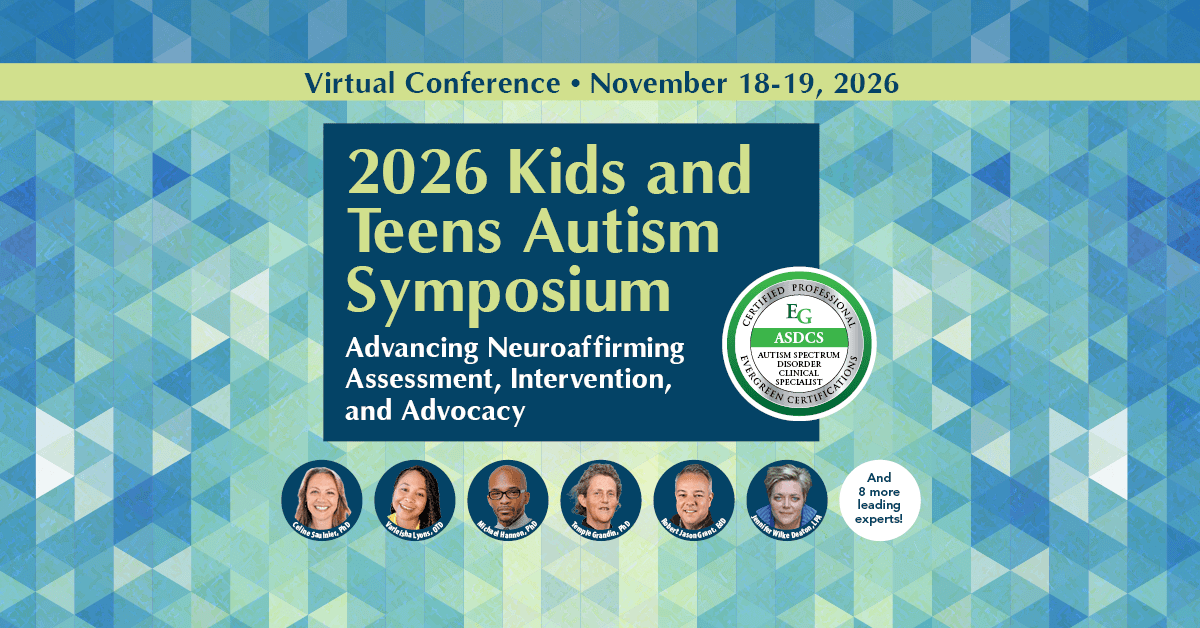
PESI's 2026 Kids and Teens Autism Symposium runs online November 18 and 19, 2026. It is a two-day neurodiversity affirming training for the people who work with autistic kids and teens, covering masking, demand avoidance, sensory regulation, siblings, and bullying. It costs $199.99, carries up to 18 CE hours, and parents can register alongside professionals.
Here is why I agreed to tell you about it.
The meeting every autism parent has already had
I can still picture a meeting from years ago. A professional across the table, folder open, walking me through what my son needed to work on.
She wasn't unkind. She wasn't lazy. She was doing exactly what she had been trained to do.
That was the problem.
Everything in that folder was about making him easier to be around. Nothing in it was about what was actually happening inside him. I drove home thinking, she is going to do this to another family next week, and she has no idea.
If you have been at this a while, you have had that meeting. Probably more than one. The evaluation that measured the wrong thing. The behavior plan that treated a nervous system like a discipline problem. The school team still using a word you stopped using years ago. The report that called your kid noncompliant when what you were watching at home was a kid who was scared.
And here is the part that makes it harder to talk about. Most of those people were trying. It would be so much easier if they were all careless. They are not. They are working from what somebody taught them, and a lot of what got taught has not aged well.
That is a different problem than not caring, and it has a different fix. I have written before about what it feels like when someone doesn't support your child's diagnosis, and the professional version of that is quieter. Nobody argues with you. They just keep handing you a plan built on the wrong idea.
The research moved. The training mostly didn't.
Autism understanding has come a long way in twenty-five years.
Autistic adults started getting listened to. We learned that masking has a cost, and that the cost gets paid later, usually at home, usually by the parent who catches the after-school collapse. We learned that demand avoidance is a nervous system doing something, not a kid being difficult. We learned that compliance and connection are not the same goal, and that chasing the first one can cost you the second.
The research moved. The training mostly did not.
A professional who got their autism education a decade ago and hasn't been back since is working from a map of a country that has changed. That is not a character flaw. It is a continuing education problem, and continuing education problems are fixable.
I have been an autism dad for twenty-five years. Three of my kids are autistic. I have sat in more of these rooms than I can count, and I can tell you exactly what the difference looks like from the parent's chair.
The professionals who changed things for us were never the ones with the most letters after their name. They were the ones who had recently learned something new and were willing to say so out loud. One person who understood what a shutdown actually was saved us a year of treating the wrong problem.
That is what training buys. Not a certificate on a wall. A year of your kid's life that doesn't get spent going the wrong direction.
What's actually on the agenda
I want to be specific here, because "great lineup of experts" is what every conference says and it means nothing.
Two sessions are the reason I said yes.
The first is about kids who hide it well. It is called "Advanced Assessment of Autism in Children, Teens and Young Adults: Differential Diagnosis, Masking and Internalizing Profiles," and it is about the kids who mask so effectively that the evaluation comes back saying something else. Anxiety. Perfectionism. A mood thing. Those kids then get treated for the wrong problem, sometimes for years, while the actual thing goes unnamed. If you have a kid who holds it together all day at school and falls apart the second the front door closes, you already know this profile. A lot of the people evaluating your kid were never taught to look for it.
The second is about kids who refuse everything. It is called "PDA, Autonomy and Nervous-System-Driven Demand Avoidance Across Development: Transforming Combative to Collaborative." Half the parents reading this have been told their kid is oppositional, defiant, manipulative, or strong-willed. This session is the other explanation, the one where the refusal is a nervous system reacting rather than a kid choosing. Seeing that on a clinical continuing education agenda is not a small thing.
The rest of the two days fills in around those:
"From Compliance to Connection: Tools to Support Joint Engagement." That title is the whole argument. There is a version of this work aimed at getting a kid to comply, and a version aimed at getting a kid to connect. They are not the same, and the second one is harder.
"Sensory, Motor, and Interoceptive Foundations for Emotional and Behavioral Regulation Across Development." Interoception is the sense that tells you what is happening inside your own body. Plenty of autistic kids have a hard time reading it. Plenty of professionals have never heard the word.
"Autistic Family and Sibling Dynamics." Siblings carry a real load and it almost never shows up on a clinical agenda. This one has its own session.
"Autism, Gender Diversity and Bullying: Protecting Youth in School and Community Spaces." Worth naming plainly.
There are also sessions on high support needs, play therapy, sandtray and expressive therapies for minimally speaking kids, and building accommodations that actually work. Temple Grandin is part of it too, in a pre-recorded conversation.
The full title of the event is "Advancing Neuroaffirming Assessment, Intervention, and Advocacy." PESI put that word in the title. It did not used to appear on clinical agendas at all.
Who this is for
Three groups, and you probably know which one you're in.
If you're a professional who follows me, and there are a lot of you, this covers material most people never got in school. The masking session alone is worth the two days. It runs November 18 and 19, it carries up to 18 CE hours, and registration also covers a Certified Autism Clinical Specialist certification for two years, which PESI prices at $249.99 on its own.
If you're a parent with somebody on your kid's team who is trying, this is the thing to forward. A kid can get evaluated, get a diagnosis, get treatment, and still end up with the wrong plan because nobody caught what was underneath. Send it to the therapist, the OT, the school psychologist, the teacher who keeps showing up. You are allowed to hand a professional a training. It is not rude. It is the most useful thing in your pocket.
And if you're the parent who is already the one explaining PDA and masking to everybody else, you can register too. This is not a closed clinical event. If you are the person other parents call, this might be worth your own time.
It is $199.99 for both days, live online with 30 days of replay, or fully on demand about four to six weeks afterward if November doesn't work.
Registration is at pesi.com/theautismdad.
Questions parents ask about this
Can a parent register for an autism training built for clinicians?
Yes. The symposium was designed for counselors, social workers, psychologists, therapists, occupational therapists, speech-language pathologists, and educators, and parents can register as well. You will be in a clinical training rather than a parent workshop, so expect the language to be clinical. If you are already the parent reading research papers at midnight, that will not be a problem.
Is this ABA training?
No. There is no applied behavior analysis content anywhere on the published agenda. The event is subtitled "Advancing Neuroaffirming Assessment, Intervention, and Advocacy," and one of the Day 2 sessions is called "From Compliance to Connection." I checked this before I agreed to anything, because I was not going to point you at a training I would not want my own kid's team sitting in. If you want my longer take on the ABA policy fights, I wrote about what actually changed with Florida and Medicaid ABA.
What if I can't make November 18 and 19?
Everyone who registers for the live event gets 30 days of replay access. There is also a fully on-demand version that becomes available roughly four to six weeks after the event.
How much does it cost, and is there a discount code?
It is $199.99 for both days. There is no promo code. PESI's page states that no additional discounts or coupons apply to this course, so anybody offering you one is guessing.
The part I actually want you to take from this
You are not difficult for wanting better than what you have been handed. You have been right about your kid this whole time.
Sometimes the missing piece is not a new therapy or a new label or one more evaluation. Sometimes it is just somebody on the team who got taught the current version instead of the one from 2014. That is a smaller gap than it feels like from where you are sitting, and it closes faster than almost anything else in this world.
If you want general information about autism and support that has nothing to do with this event, the Autism Society keeps a solid set of resources.
So tell me this. What is the one thing you wish every professional working with your kid actually understood? I read the comments, and I have a feeling a few of you are going to name the exact same thing.
This post is sponsored by PESI. They are paying me to tell you about their autism symposium. I said yes because I read the agenda first, and I would not have said yes if I hadn't.