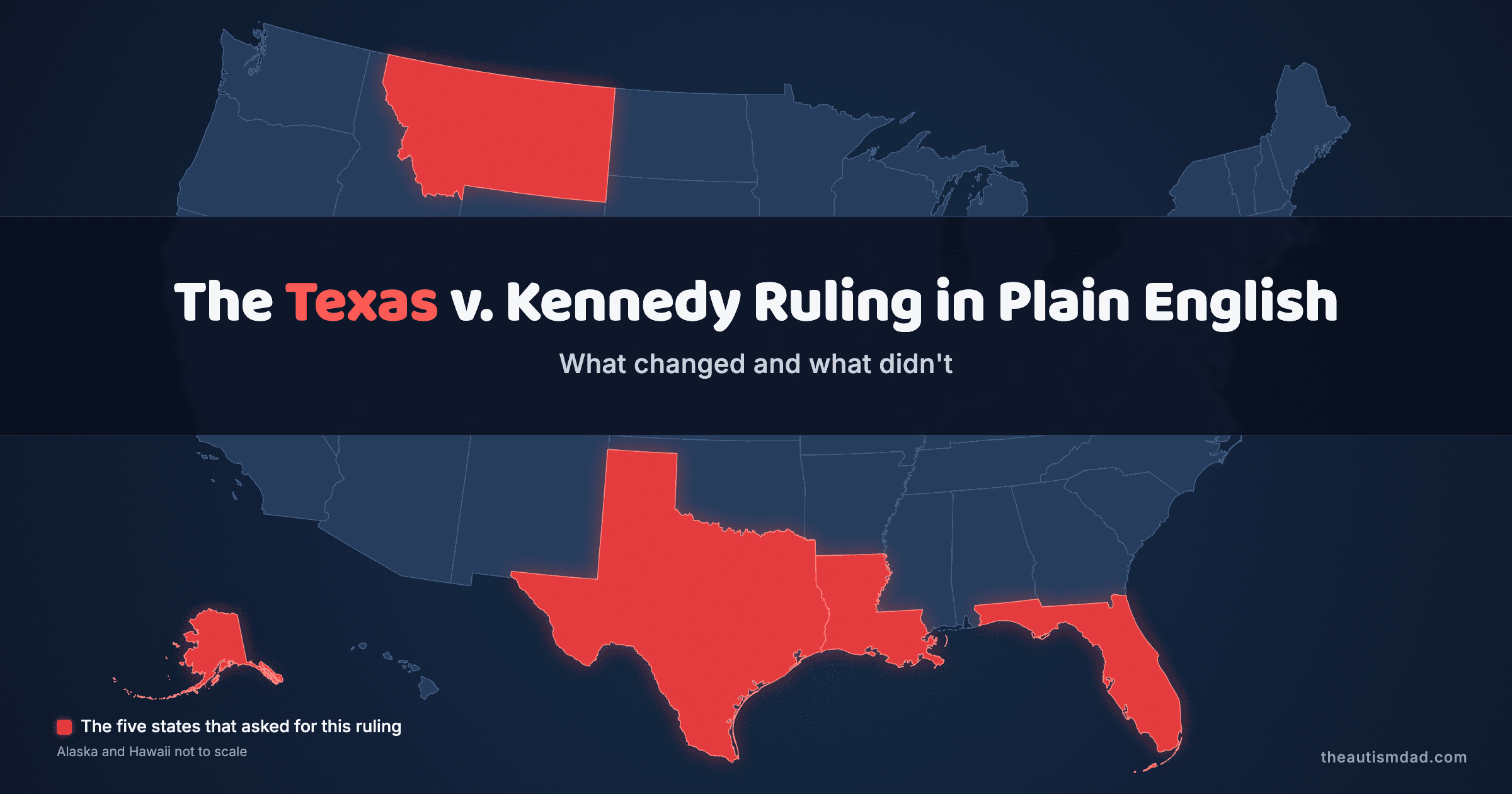
Update, September 25, 2026: on September 23 a federal judge ended Texas v. Kennedy by striking HHS's community integration rules, nationwide. Here's what that ruling does and doesn't do. One correction: this post said six states were still in that case. Missouri had withdrawn on July 20, so it was five.
Last week the government put something in writing. It was quiet. No press event. Just a notice in a place most people never look.
But if you love someone with a disability, that notice is about your family.
I've been an autism dad for 25 years. My three sons are adults now. The support they get at home is the reason our life works. So I read the whole thing. Then I read it again.
Here it is, in plain words.
What just happened
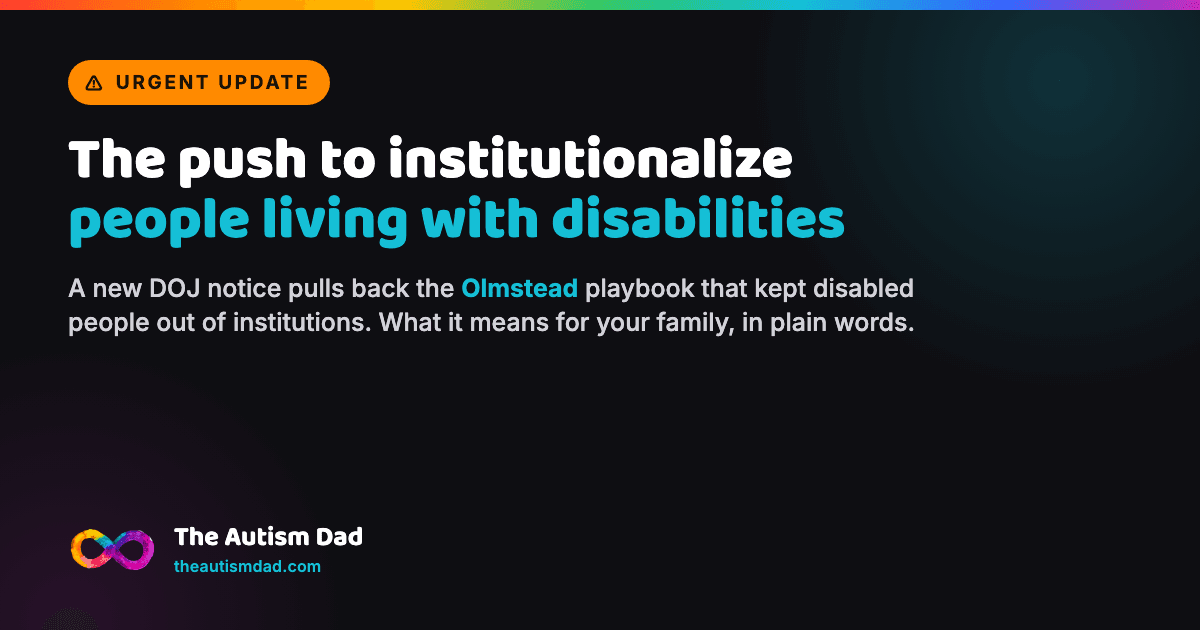
On Monday, July 20, the Trump administration's Justice Department published a notice in the Federal Register. That's the government's official newspaper.
The notice says two big things.
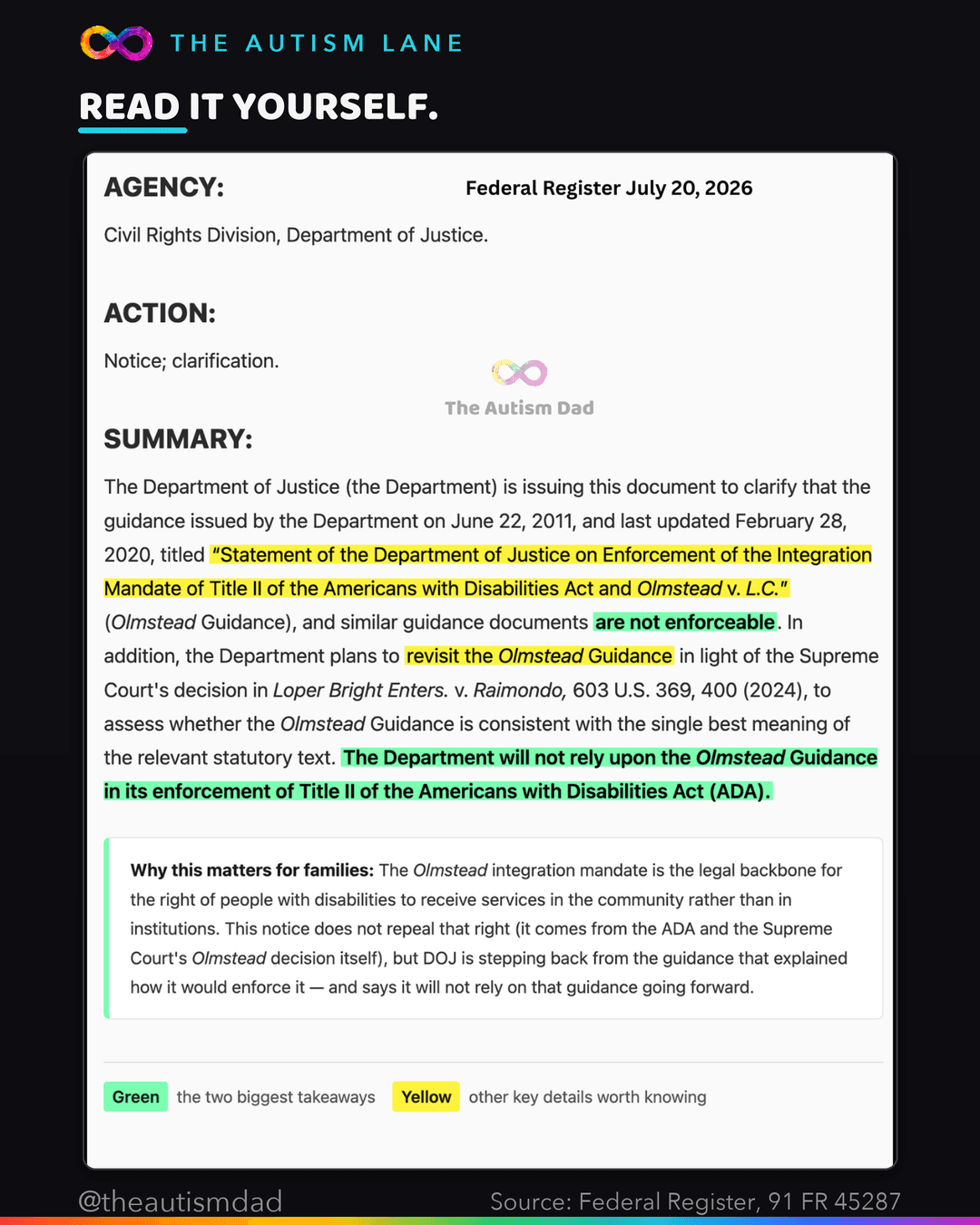
The DOJ's own Olmstead guidance "and similar guidance documents are not enforceable."
The DOJ "will not rely upon the Olmstead Guidance" when it enforces the ADA.
It's signed by Harmeet Dhillon. She leads the DOJ's Civil Rights Division. That's the office in charge of protecting disability rights.
You can read the notice yourself. It's short. The link is in the sources at the bottom of this post.
What is Olmstead?
Olmstead is a Supreme Court case from 1999. Two women in Georgia, Lois Curtis and Elaine Wilson, were kept in a state hospital. Their own doctors said they didn't need to be there. They wanted to live in the community. The Court said keeping them locked away was discrimination.
That ruling gave disabled people a real right. The right to live at home, in their own community, with support. Not in an institution.
In 2011, the DOJ wrote a guide that explained the ruling. It told states what they had to do. Things like funding services at home instead of beds in facilities. For 15 years, that guide was the playbook. Courts used it. States followed it. Families leaned on it without ever knowing its name.
What did not change
Take a breath with me, because this part matters.
Olmstead still stands. It's a Supreme Court ruling. A notice can't erase it.
The ADA is still the law. So is Section 504.
Your family's services don't end this week because of this notice.
Nobody should panic. That's not what this post is for.
What did change
Think of it like a referee at a game.
The rules of the game didn't change. But the referee just told everyone he's putting away the rulebook he's used for 15 years.
The rules still exist. The question is whether anyone will enforce them the same way.
The DOJ's job is to step in when a state fails disabled people. The 2011 guide told states exactly what was expected. Now the DOJ says it won't rely on that guide anymore. It also says it plans to rethink the guide itself.
Here's the part that stays with me. The notice admits that "numerous courts have treated the Olmstead Guidance as authoritative." That's the DOJ's own sentence. This wasn't some dusty memo. It was a document courts leaned on. And the referee just benched it.
The third move in six weeks
This notice didn't happen alone. Look at the pattern.
June 18: the Trump administration's DOJ released a legal memo. It argues the ADA doesn't require states to serve disabled people in the community. I broke that memo down here when it dropped.
Since then: the administration is backing six states in a lawsuit called Texas v. Kennedy. That suit asks a court to throw out the rule behind Section 504's promise of community living.
July 20: this notice.
Three moves. Six weeks. All in one direction. Away from the right to live at home.
I'm not going to guess their motives. I don't have to. The direction speaks for itself.
What this could mean for everyday life
Here's the honest answer. Nothing changes overnight. And that's exactly why this is easy to miss.
Home and community services are things like:
A support person who helps your child or adult child get through the day
Respite care, so you can sleep, work, or just breathe
Day programs and job coaches
Medicaid waivers that pay for support at home instead of a facility bed
States decide a lot about these services. Budgets get tight. Waitlists grow. For 15 years, states knew the federal referee was watching. That pressure kept doors open.
If the referee steps back, watch for slow changes like these:
Waiver renewals that get harder or slower
Fewer approved hours of support
Longer waitlists, and less urgency to fix them
More families told a facility is "the only option"
Group homes and providers closing, with no plan to replace them
None of that is certain. It will look different in every state. But this is how rights fade in real life. Not with one big announcement. With a hundred small decisions nobody is watching anymore.
What families can do right now
Calls work. I can prove it.
When Texas v. Kennedy started, nine states were suing. Three of them dropped out. Indiana, South Dakota, and Kansas all walked away. Why? Families and advocates kept calling and wouldn't let go.
Here's your two-minute version.
Step 1. Go to my Take Action page. The scripts are ready.
Step 2. Pick the call script or the email. Add one line about your own family.
Step 3. Send it to your governor and your state legislators.
Then do one more thing. Tell one other family. This notice was filed quietly. Quiet is what they're counting on.
And if the news cycle is wrecking you, I wrote about how to survive the news as an autism parent. Protect your peace while you fight.
Common questions about the Olmstead notice
Did they overturn Olmstead?
No. Olmstead is a Supreme Court decision. It still stands. This notice pulls back the DOJ's own enforcement guide. That's serious. But it's not the same thing.
Is the ADA still the law?
Yes. The ADA is a law passed by Congress. So is Section 504. A notice can't repeal a law. The fight right now is over how those laws get enforced, and whether they get enforced at all.
Will my child lose services this week?
No. Nothing in this notice cuts services directly. The risk moves slower than that. It's about what states do next, once they believe nobody is checking. That's why state-level advocacy matters so much right now.
What is "guidance," and why does it matter if it isn't law?
Guidance is the instruction manual an agency writes to explain a law. It isn't a law itself. The DOJ is right about that. But this manual is what made the law real. States built programs around it. Courts cited it. When the manual goes away, every fight gets harder and slower.
What is Texas v. Kennedy?
It's a lawsuit where states are asking a court to strike down the rule that protects community living under Section 504. Six states are still in it. Disability groups are filing court briefs against it this week. Three states already walked away because of public pressure. DREDF tracks the case here.
How will I know if my state is pulling back?
Watch your own paperwork. Waiver renewals, service hours, provider letters. If something shrinks, ask why in writing. Join your state's disability groups, because they see patterns before any one family can. And if you see a change, speak up early. Early is when calls work best.
Where can I read the actual notice?
Right here: the Federal Register notice. Read the two sentences I quoted at the top of this post and you'll know the heart of it.
You're not alone in this
Twenty-five years into this life, here's what I know. Our families don't get to sit news cycles out. But we're not powerless either. Three states already proved that.
My sons live at home, in their community, with the people who love them. That's what Olmstead promised every disabled person in this country. It's worth defending.
My book has a whole section on building the team around your child, because none of us should have to figure this out alone. You can find it at theautismdad.com/book. That's also what this blog is for.
So here's my question for you. What does support at home make possible for your family? Tell me in the comments. Your story might be the thing another parent needs to read today.
We'll talk soon.