The short version
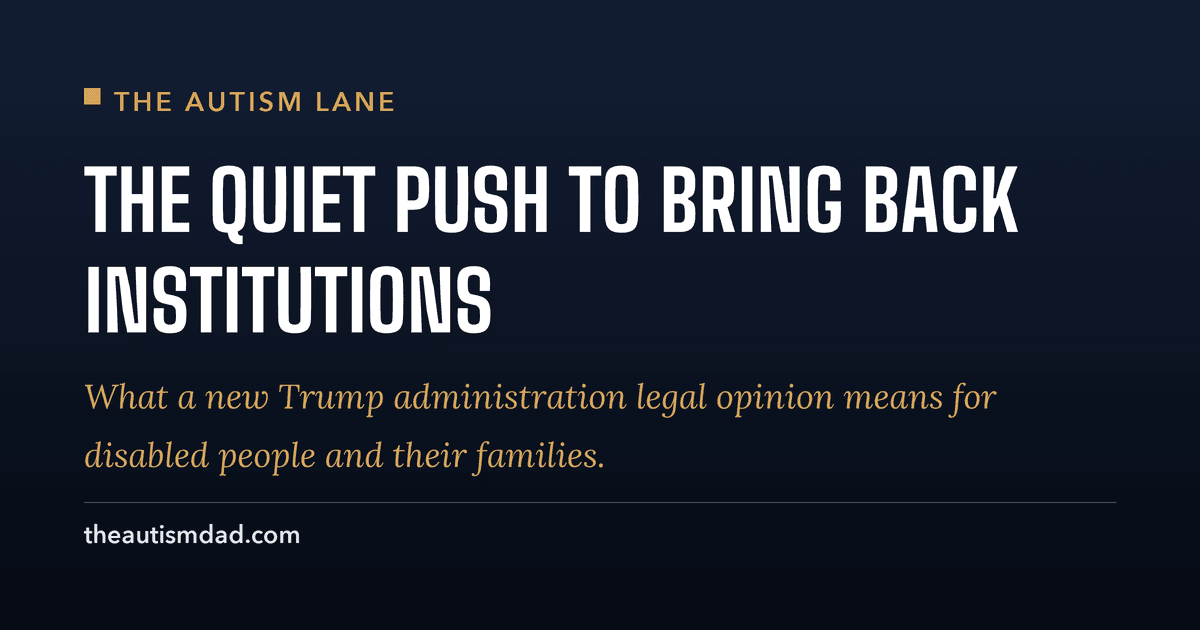
On June 18, 2026, at the Trump administration's request, the Justice Department's Office of Legal Counsel issued a legal opinion saying the integration mandate, the rule that requires states to serve disabled people in their communities instead of locking them away in institutions, was never actually required by law. It is not a court ruling and it does not change anything overnight. But it is the legal permission slip the Trump administration needs to cancel that rule and stop enforcing it. If that happens, a state could place a disabled person in an institution, say it ran out of community funding, and it would no longer count as discrimination. Here is how that works, the right they are going after, and what you can do.
For 35 years, one rule has quietly kept disabled people out of institutions and living in their own communities. This week, the Trump administration moved to erase it.
It did not make headlines. It showed up as a 39-page legal memo with a title only a lawyer could love. But if you have a disabled kid, or a disabled adult you love, this is one of the most important things to land in a long time. So let me walk you through what it actually says. No spin. No panic. Just what is happening and why it matters.
What actually happened
On June 18, the Office of Legal Counsel put out an opinion. That office is the part of the Justice Department that tells the rest of the government what the law means. The Trump White House asked for this one. The question on the table was simple. Is the government actually required to make states care for disabled people in the community instead of in institutions?
For 35 years the answer has been yes. This opinion says no.
It says the integration mandate, the rule behind decades of work to move people out of institutions and into group homes, supported apartments, and their own family homes, was never really required by the Americans with Disabilities Act or the Rehabilitation Act. And it says the two agencies that wrote that rule, Health and Human Services and the Justice Department, can simply take it back.
How institutions come back, step by step
This is the part I want you to understand, because it does not look like what you would expect. Nobody is going to stand at a podium and announce that institutions are back. It happens in steps, on paper, in language that sounds boring on purpose. Here is the path the Trump administration has started down.
Step 1. Redefine discrimination so institutionalizing someone almost never counts
The opinion says that putting a disabled person in an institution is only discrimination if their disability is the sole reason for it. As long as the state has any other reason, it is not discrimination under the law. That sounds technical. It is not. It is the whole fight, and you will see why in the next step.
Step 2. Pre-approve we do not have the money as a legal excuse
The opinion goes ahead and lists the reasons that count as legitimate. Resource constraints. Not enough room in community programs. Safety concerns. In plain language, a state can say we do not have community capacity, or we do not have the funding, place someone in an institution, and under this opinion that is not a civil rights violation.
Sit with that for a second. Almost every state in the country is short on community funding. Almost every state has waiting lists for home and community based services that run for years. This opinion takes the most common reason families get stuck, no funding and no capacity, and turns it into a lawful reason to institutionalize instead.
Step 3. Declare the rule itself illegal, then cancel it
The opinion does not stop at reinterpreting the law. It says the regulations that created the integration mandate are unlawful, and that the Trump administration's HHS and Justice Department can rescind them. The opinion is the argument. The rescission is the action. When you see a news story about HHS or DOJ moving to cancel or rewrite this rule, that is the moment this stops being theory.
Step 4. Pull the enforcement that made it real
For two decades, the Justice Department's Civil Rights Division used this rule to pressure states into moving people out of institutions, often through court agreements called consent decrees. About a dozen states are under those agreements right now. Take away the rule and you take away the teeth. The agreements that forced states to build community options lose their backing.
The right they are erasing
The integration mandate did not come out of nowhere. In 1999, the Supreme Court decided a case called Olmstead v. L.C. It involved two women with disabilities who were kept in a Georgia psychiatric hospital even after their own doctors said they were ready for community care. The Court held that keeping disabled people locked in institutions without a good reason is a form of discrimination.
That decision is the reason the integration mandate has had real force for a quarter century. It is the legal floor under the right to live in your own community. This new opinion reads that case down to almost nothing, and argues the rule built on it has to go.
Why this lands on autism and intellectual and developmental disability families
Here is why I am not treating this as someone else's problem. The opinion uses the phrase mental disability to cover intellectual disability, developmental disability, and mental illness all at once. That means autistic people and people with intellectual and developmental disabilities are squarely inside it.
The integration mandate is the floor under group homes, Medicaid waivers, day programs, and supported living. It is the legal reason a person with high support needs has a path to a life in the community at all. Take away the floor, and the people with the highest support needs are the first to fall through. It fits a wider pattern this year, from the push to collect families' medical records to the steady squeeze on the services disabled people rely on.
This is not abstract for me. One of my sons is disabled and relies on Medicaid and exactly the kind of community based support this rule protects. The integration mandate is part of what stands between a full life and being warehoused somewhere out of sight. After 25 years of being an autism dad, I have learned that the systems holding our kids up are stronger than they look on a good day and more fragile than anyone admits on a bad one. I write about that fragility, and how to navigate it, in my book at theautismdad.com/book. This opinion is a reminder of why that floor matters.
Alison Barkoff, a former Justice Department disability rights official, told CBS News what is really at stake. The reason community integration matters, she said, is "so children can be part of their families, so they can go to school, so people can be part of their communities. That's what's at stake."
The honest part
I am not going to tell you the sky has fallen, because that is not true and you deserve straight talk. An opinion from the Office of Legal Counsel is not a court ruling and it is not a finished regulation. Nothing about your services changes today because of it.
The opinion even admits it is out of step with how almost every federal appeals court has read Olmstead, and it basically expects to be challenged in court. So the danger is real, but it is not done. This is the opening move, not the final one. The moment to watch is when the Trump administration's HHS or Justice Department formally move to cancel or rewrite the rule. That is when the fight becomes real, and that is when our voices count the most.
I am not the only one reading it this way. Regan Rush, an attorney at the legal group Democracy Forward, said it plainly. "This opinion does not change the law, but it is a clear warning shot aimed at the legal framework that has protected those rights."
What you can do right now
Understand it and share it. Most people, including most reporters, have no idea this happened. Plain language spreads. Send this to one other parent who would want to know.
Watch for the rule change. The danger is not the opinion, it is the rescission that follows. When HHS or DOJ open a formal process to change this rule, there is usually a public comment period. That is a place where families can be heard.
Contact your federal representatives. Tell them you oppose any move to weaken the integration mandate or the right of disabled people to live in their communities. You do not need to be a policy expert. You need to be a parent who votes.
Keep your records. Document the services your family relies on and what they make possible. If you ever have to fight for them, the paper trail matters.
Do not panic. Organize. Fear scatters people. A clear head and a phone full of other parents is how this gets pushed back.
Frequently asked questions
What is the integration mandate?
It is the rule that says states have to serve people with disabilities in the most integrated setting that fits their needs, which usually means the community rather than an institution. It comes from regulations under the Americans with Disabilities Act and the Rehabilitation Act, and it was reinforced by the Supreme Court in Olmstead v. L.C.
What was the June 18, 2026 opinion?
It is a legal opinion from the Justice Department's Office of Legal Counsel, requested by the White House. It concludes that federal law never actually required the integration mandate and that the agencies can take the rule back.
Does this mean my child will be institutionalized?
No. Nothing changes automatically because of this opinion. It is a legal argument, not a court order and not a finished regulation. It matters because of what it makes possible next, not because of anything it does on its own today.
Is this law now?
No. An Office of Legal Counsel opinion guides what the executive branch does, but it is not a statute or a court ruling. The opinion itself expects to be challenged in court if the government acts on it.
What is Olmstead?
Olmstead v. L.C. is a 1999 Supreme Court decision holding that the unjustified institutional isolation of people with disabilities is a form of discrimination. It is the legal backbone of community living for disabled people in the United States.
You are not imagining the ground shifting under our families. You are paying attention, and paying attention is the first job. The people who built community living did it one fight at a time. We can defend it the same way.
If your family relies on community based services, tell me in the comments. What would you lose if they disappeared? I read these, and your story is the thing that moves people who have never had to think about this.
Sources and background
I always want you checking my work, especially on something this important. Here are the primary documents and the reporting, so you can read this for yourself.
The opinion itself. U.S. Department of Justice, Office of Legal Counsel, Application of the Rehabilitation Act and Americans with Disabilities Act to State Institutionalization of Patients with Severe Mental Illness or Disabilities, slip opinion, June 18, 2026. Official PDF at justice.gov/olc/media/1446701/dl, indexed at justice.gov/olc/opinions.
Olmstead v. L.C., 527 U.S. 581 (1999). The Supreme Court decision holding that unjustified institutional isolation of people with disabilities is discrimination.
The two laws at issue. The Americans with Disabilities Act, Title II, 42 U.S.C. 12132, and Section 504 of the Rehabilitation Act, 29 U.S.C. 794.
The regulations the opinion targets. 28 C.F.R. 35.130(d) (Justice Department) and 45 C.F.R. 84.76(b) (Health and Human Services), which contain the integration mandate.
CBS News, States aren't required to provide community-based care for people with disabilities, new DOJ opinion claims, June 18, 2026, at cbsnews.com/news/doj-disability-opinion-community-care.
ADA.gov, Olmstead: Community Integration for Everyone, at archive.ada.gov/olmstead, for plain-language background on the integration mandate.
U.S. Department of Health and Human Services, Office for Civil Rights, Community Living and Olmstead, at hhs.gov/civil-rights/for-individuals/special-topics/community-living-and-olmstead.
Rob Gorski is The Autism Dad. He has written about raising autistic kids for over 15 years and is the author of the forthcoming book So Your Child Was Just Diagnosed with Autism. Learn more at theautismdad.com/book.