I want to talk about something that nobody talks about in the autism community because it makes people uncomfortable. And that's grief.
Not the kind of grief where you lost your child. Your child is right here. Your child is exactly who they're supposed to be, and you love them with everything you have. That's not what this is about. I want to make that absolutely clear before I say anything else, because this topic gets twisted and weaponized all the time, and I refuse to let that happen here.
This is about the other grief. The quiet kind. The kind that hits you at random moments when you're not expecting it.
The Grief Nobody Gives You Permission to Feel
It hits you when you see another family doing something easily that's impossible for yours. A birthday party where every kid is running around and laughing, and you're watching yours struggle to regulate in the corner. A restaurant where another family is casually eating dinner while you're mentally mapping every exit in case you need to make a quick getaway. A grocery store where someone else's kid is happily picking out snacks while yours is melting down over fluorescent lights that sound like a jet engine in their head.
It hits you when your friend's kid hits a milestone and you're still waiting. When your social media feed is full of first days of school, team photos, school dances, and graduations that look nothing like what your family is experiencing.
It hits you when you catch yourself imagining what your child's life might have looked like if things were different. Not because you want a different child. But because you want the world to be kinder to the one you have.
It hits you when you realize that the version of parenting you imagined isn't the version you got. When you see a glimpse of the life you thought you'd be living and you have to sit with the fact that it's not the life you ended up with.
That's not failure. That's not betrayal. That's not loving your child any less.
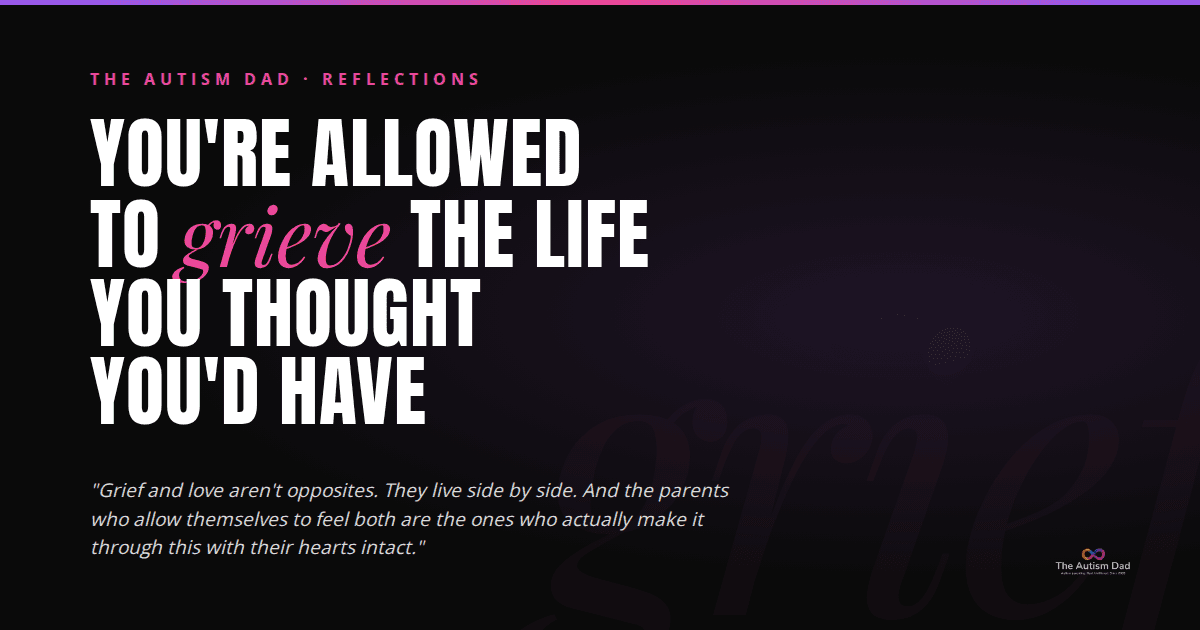
That's grief. And it's allowed.
Both Things Can Be True: Loving Your Autistic Child and Grieving at the Same Time
Here's what I've learned in 25 years of raising three autistic kids. You can love your child with every cell in your body and still grieve the version of parenting you imagined. You can be unbelievably proud of who they are and still feel sad about what's hard. You can celebrate every win and still cry in the car after the appointment that didn't go the way you hoped.
Both things can be true at the same time. They have to be. Because that's what this life actually looks like.
The problem is nobody gives you permission to feel both. People want you to pick one. They want you to be either the inspirational autism parent who loves every single minute of it, or the tragic parent who "lost" the child they expected. Neither of those caricatures is real. Neither of them is you.
You're a real parent feeling real things. And both of those things are valid.
Why Autism Parents Stay Silent About Grief
Most autism parents never talk about this grief because they're terrified of being misunderstood. They're afraid that if they admit to grieving anything, someone will accuse them of not loving their child. Or wanting their child to be different. Or seeing autism as a tragedy. Or not accepting who their child actually is.
So we shove it down. We smile through the appointments. We post the good stuff. We nod when people tell us our kids are amazing, which they are. And we carry the other stuff in silence because it feels too dangerous to say out loud.
That silence is hurting people.
When you don't give parents permission to feel complicated things, they don't stop feeling them. They just stop talking about them. And when they stop talking about them, they start believing they're the only ones. That something is wrong with them. That they're a bad parent because they had a hard day, or a hard year, or a hard decade.
That's not okay. That's not sustainable. And it's not what this community should be doing to each other.
What Autism Parent Grief Actually Looks Like
Let me be specific about what I'm talking about, because I think clarity matters here.
The grief isn't about your child. It's about all the things the world doesn't give them. It's about the services that got cut. The friendships that never materialized because other kids didn't know how to connect. The teachers who didn't get it. The relatives who stopped inviting you over because your kid was "too much." The doctors who dismissed your concerns. The people in your own family who told you that you were overreacting or that you just needed to discipline better.
The grief is about watching your child struggle with things that should have been easier. It's about the fear that wakes you up at 3 a.m. and won't let you go back to sleep. It's about wondering what happens to them when you're not around to advocate anymore. It's about the exhaustion of having to explain, defend, and fight for your child every single day.
The grief is about carrying all of that while the rest of the world acts like you should just be grateful and positive and inspirational.
It's about being a human being parenting in an incredibly hard situation with not enough support, not enough rest, and not enough understanding.
Permission to Feel: A Message to Grieving Autism Parents
So if you're sitting with that quiet grief tonight, the kind you don't talk about because you're afraid people will think you don't love your child, I need you to hear this from someone who has been in this for 25 years.
It's okay.
It doesn't make you a bad parent. It doesn't mean you wish your child was different. It doesn't mean you're failing. It doesn't mean you love them any less than the parent who seems to have it all figured out on Instagram.
It means you're human. It means you're carrying something most people will never understand. It means you're doing this for real, with all the complexity that real life comes with.
Let yourself feel it. Don't shove it down. Don't pretend it isn't there. Don't apologize for having feelings. Don't let anyone, especially not yourself, convince you that grief and love are opposites.
Because they're not. They live side by side. They always have. And the parents who allow themselves to feel both are the ones who actually make it through this with their hearts intact.
What Helps When You're Grieving as an Autism Parent
I'm not going to tell you how to process your grief because I don't know your life and I'm not a therapist. But I can tell you what's helped me over the years.
Find Your People
Talk to other autism parents who get it. Not the ones who post perfect Instagram content. The real ones. The ones who will tell you about the hard days without flinching. The ones who understand that you can love your kid and still have a bad day. Find your people.
Give Yourself Permission
Give yourself permission to have feelings without needing to justify them. You don't have to explain why you're sad. You don't have to earn the right to grieve. You don't owe anyone a disclaimer about how much you love your kid before you're allowed to admit that something is hard.
Let the Feelings Come in Waves
Grief isn't linear. It doesn't follow a timeline. Some days are fine. Some days are not. That's normal. That's part of the process.
Talk to a Professional
Talk to a professional if you need to. There is no shame in getting help. A therapist who understands autism families can be life-changing. If you're struggling, please reach out to someone.
Take Care of Yourself
You can't pour from an empty cup. Rest when you can. Eat when you can. Sleep when you can. Your kid needs you to be okay too.
You Are Allowed to Grieve and Love at the Same Time
You are allowed to grieve. You are allowed to love. You are allowed to feel everything at once. That's not a contradiction. That's parenting an autistic child in a world that wasn't built for them.
The grief doesn't mean you love your child any less. In a lot of ways, it means you love them more. Because you're feeling everything. You're holding space for the joy and the pain and the fear and the fierce love all at the same time. You're not picking one and pretending the others don't exist.
That's not weakness. That's the full human experience of loving a child who the world doesn't always know how to handle.
So the next time that quiet grief hits you in the car after an appointment, or standing in the grocery store watching another family have an easy day, or late at night when your brain won't shut off, don't run from it. Don't apologize for it. Don't decide it means something it doesn't mean.
Just let it exist. Feel it. And then keep going. Because your child needs you. And you're doing better than you think you are.
We'll talk soon.
If this resonated with you, please share it. Someone else in our community is carrying this silently and needs to know they're not alone. And if you're new here, welcome. This is a space where real autism parents get to feel real things without apology.